RAID technology
RAID Info
How to choose the right video recording server (NVR)?
When it comes to continuous video recording, 24 hours a day, 7 days a week, the performance and reliability of the NVR server are essential. The quality of HD and Super HD streams requires stable write speeds, high endurance, and foolproof data protection.
One of the most critical factors when choosing a server is the RAID configuration. Although RAID has been used in IT for a long time, it must be chosen carefully for the specific needs of video surveillance, where sequential writes are constant and voluminous.
This page explains in simple terms the difference between RAID 5 and RAID 10, why RAID 10 is the preferred solution for professional video recording, and how the DataCAM configuration maximizes the performance, durability, and peace of mind of your installations.

RAID 5 vs. RAID 10 configuration
The difference in performance
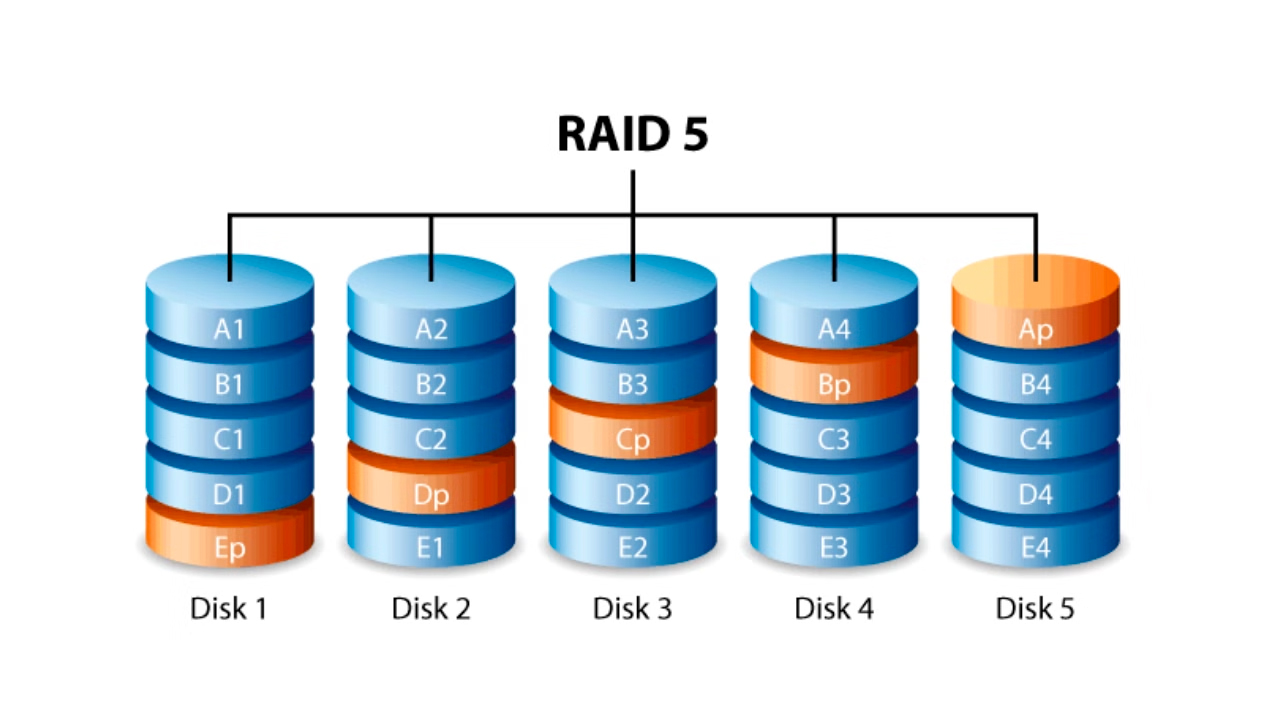
RAID 5
RAID 5 uses parity for redundancy, offering good storage capacity but slower write performance due to parity calculation.
In this mode, if disk #1 fails, it must rebuild the new disk with the information distributed across the other four disks. This requires a significant amount of time for parity calculation.
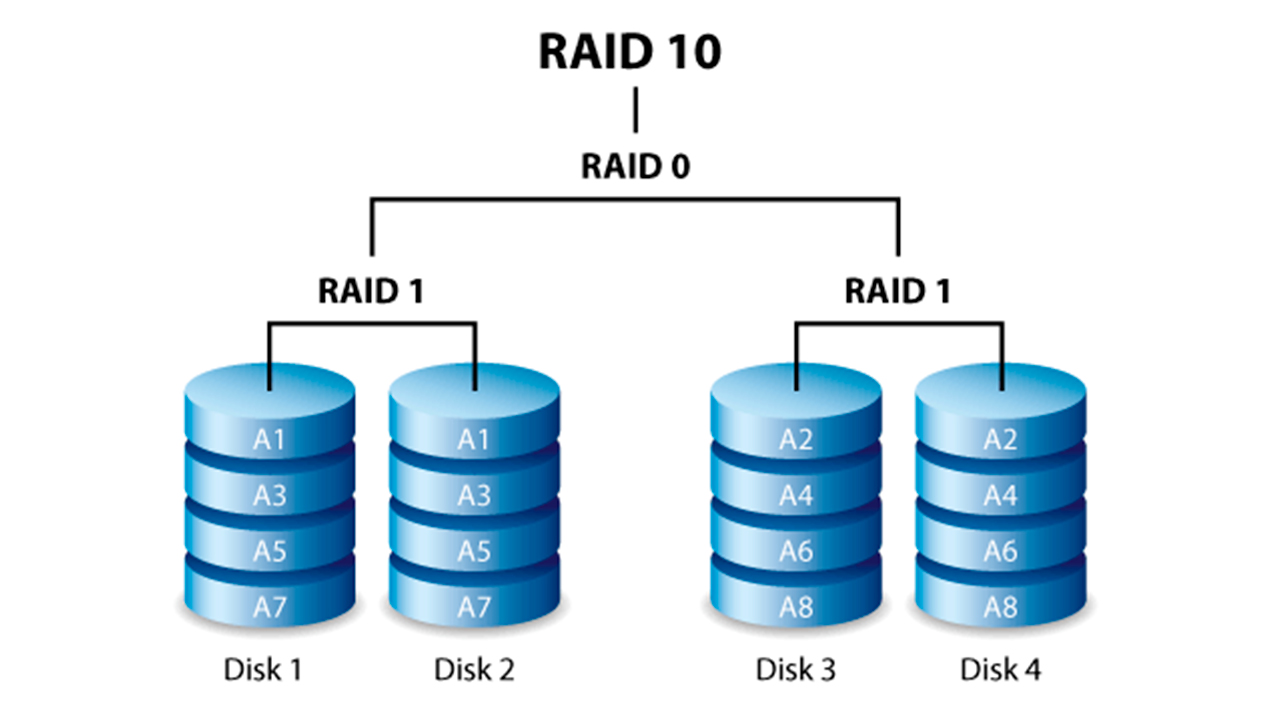
RAID 10
RAID 10 combines mirroring and data block writing across multiple disks at the same time, resulting in faster read and write performance.
In RAID 10 mode, however, if disk #1 fails, it will simply rebuild the new disk with the information from disk #2 without the need to calculate the parity distributed across multiple disks.

The facts
There is no universal percentage for the difference in performance between RAID 5 and RAID 10, as it depends on workloads, hardware, and configurations. In general, RAID 10 is about two to three times faster for writing and up to 30 to 50% faster for reading, as no parity calculations are required.
Rebuild
The rebuild time for a disk after a failure is VERY long with high-capacity disks used with NVRs. In RAID 5 mode, the rebuild time takes about 8 days for a 20TB disk, and in RAID 10 mode, the rebuild time is reduced to about 32 hours, as it performs a direct copy without parity calculations.
In conclusion
For 24/7 video recording, where sequential writes dominate, RAID 10 offers approximately 50 to 100% faster write performance than RAID 5, depending on the hardware and number of disks.
The exact difference varies, but RAID 10 excels thanks to its lack of parity calculations. Reads are also 20 to 40% faster, which helps with simultaneous playback.

Optimized approach
The DataCAM difference
At DataCAM, each server is designed to simplify your work, increase the reliability of your installations, and offer your end customers flawless video performance. Our approach is based on a comprehensive, optimized, turnkey configuration, so you can deploy faster, reduce the risk of errors, and ensure consistent quality on every project.
Customization
Windows version of your choice—Win 11 Pro/Windows Server 2022/French/English.
Updates
All Windows updates are already installed, as well as the required drivers.
Optimized RAID
The RAID configuration is already programmed and optimized for video surveillance.
Time savings
Since the basic configuration is already complete, you save time during installation.
Actual capacity
Since you receive the servers already configured, the number of TB displayed is usable and not raw.
Pro drives
The hard drives used for PREMIUM versions are NOT 6 Gb/s SATA HDDs, but 12 Gb/s Enterprise SAS drives managed by a Broadcom physical RAID card.
Fast delivery
In the vast majority of cases, delivery takes less than two weeks.
Talk to a DataCAM expert
Questions? Call us at 1-888-990-9961